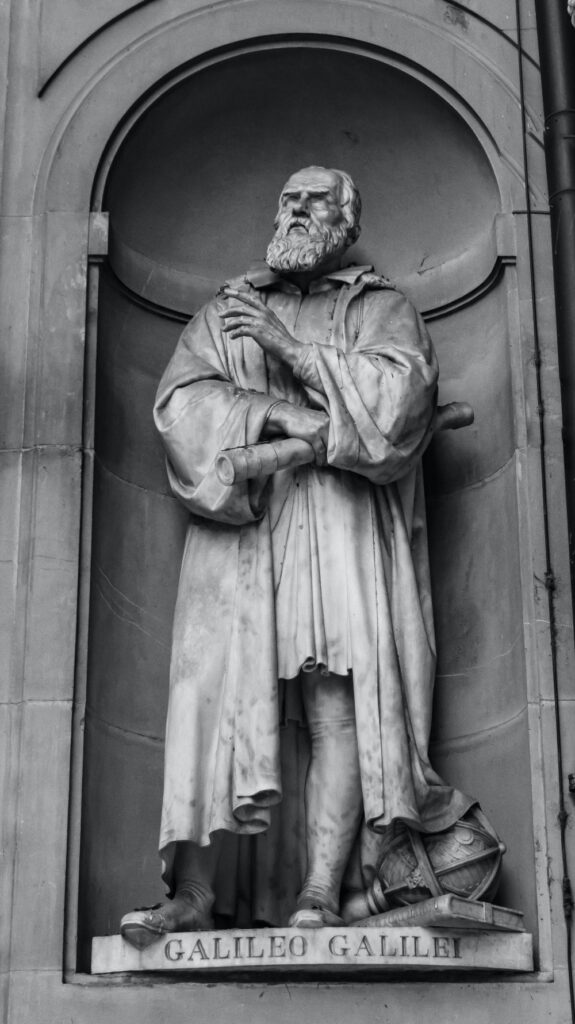
Credits to Juan Martin Lopez
Galileo Galilei, born in 1564 in Pisa, Italy, was a visionary astronomer, physicist, and mathematician whose work revolutionized our understanding of the universe. Galileo’s contributions to science and his use of the scientific method laid the foundation for modern physics and astronomy, and his ideas challenged the traditional views of the Church and the wider society of his time.
Galileo’s early work as a student focused on mathematics and natural philosophy. He developed a keen interest in the motion of objects and the laws that govern their movement, and his studies of motion laid the groundwork for his later work in astronomy.
One of Galileo’s most important contributions to science was his use of the telescope to observe the heavens. In 1609, he built his own telescope and began making detailed observations of the moon, the planets, and the stars. Through his observations, Galileo was able to challenge the traditional Aristotelian view of the universe, which held that the earth was at the center of the cosmos and that all celestial bodies revolved around it.
Galileo’s observations of the moon revealed that its surface was not smooth, but was instead marked by mountains, valleys, and craters. He also observed the phases of Venus, which provided evidence that the planet orbited the sun, rather than the earth. These discoveries challenged the traditional view of the universe, and sparked a new era of scientific exploration and discovery.
Galileo’s work in astronomy also led him to develop new theories about the laws of motion and the behavior of objects in space. He proposed that all objects fall at the same rate, regardless of their weight or composition, and that objects in motion will remain in motion unless acted upon by an external force. These ideas were later incorporated into Isaac Newton’s laws of motion, which revolutionized the field of physics.
Galileo’s work was not without controversy, however. His support for the heliocentric model of the universe, which placed the sun at the center of the cosmos, challenged the traditional views of the Church and the wider society of his time. In 1632, he published his book “Dialogue Concerning the Two Chief World Systems,” which presented arguments in favor of the heliocentric model. The book was perceived as an attack on the Church’s authority and was subsequently banned, and Galileo was placed under house arrest for the rest of his life.
Despite the challenges he faced, Galileo’s legacy as a visionary and innovator in science and astronomy has had a lasting impact on our understanding of the universe. His use of the telescope to make detailed observations of the heavens paved the way for modern astronomy, and his development of the scientific method laid the groundwork for modern physics and scientific inquiry.
Criticism and Opposition
While Galileo Galilei was revered by many in the scientific community for his groundbreaking work in astronomy and physics, he faced significant opposition and criticism from those who challenged his ideas and theories.
One of the main sources of opposition to Galileo’s work came from the Church, which saw his support for the heliocentric model of the universe as a challenge to its authority and teachings. The Church’s traditional view held that the earth was at the center of the cosmos, and that all celestial bodies revolved around it. Galileo’s work, which challenged this view, was seen as a direct threat to the Church’s teachings and authority.
Galileo’s ideas also faced opposition from many within the scientific community, who were skeptical of his theories and methodology. Some of his contemporaries criticized his use of the telescope, arguing that it was unreliable and could not be used to make accurate observations of the heavens. Others challenged his theories about the laws of motion and the behavior of objects in space, arguing that they were not supported by empirical evidence.
Despite the opposition he faced, however, Galileo remained committed to his ideas and theories, and continued to pursue his work in astronomy and physics. His willingness to challenge traditional views and to pursue his own ideas and theories, even in the face of opposition, serves as a reminder of the importance of visionary thinking and the power of individual action to effect positive change in the world.
Galileo’s legacy as a visionary and innovator in science and astronomy continues to inspire and influence scientists and thinkers around the world today. His example serves as a powerful reminder of the importance of pursuing knowledge and understanding, even in the face of opposition and criticism, and of the transformative power of individual action and commitment to a cause.
Galileo’s legacy also serves as a reminder of the power of visionary thinking and the importance of challenging traditional views and ideas. His willingness to challenge the traditional views of his time and to pursue his own ideas and theories in the face of opposition has inspired generations of scientists and thinkers to pursue their own ideas and to push the boundaries of human knowledge and understanding.
Galileo Galilei’s legacy as a visionary and innovator in science and astronomy is a testament to the power of human curiosity and the importance of pursuing knowledge and understanding, even in the face of opposition and controversy. His contributions to science and his use of the scientific method laid the foundation for modern physics and astronomy, and his legacy continues to inspire and influence scientists and thinkers today.
Galileo Galilei’s story is a powerful reminder that anyone, regardless of their background or circumstances, has the potential to change the world through their ideas, actions, and commitment to a cause. Galileo was a visionary who challenged traditional views and ideas, and pursued his own ideas and theories with unwavering dedication and commitment, despite facing opposition and criticism from others. His example serves as an inspiration to anyone who seeks to make a difference in the world, and reminds us that it is possible for one person to effect positive change and shape the future of the world.