Isaac Newton, a name synonymous with scientific genius, stands as one of the most influential figures in the history of physics and mathematics. Born in 1642, the same year that Galileo Galilei passed away, Newton would go on to revolutionize our understanding of the universe, laying the foundation for classical mechanics and shaping the course of scientific thought for centuries to come. This article delves into the life, achievements, and enduring legacy of Sir Isaac Newton, the visionary who unraveled the secrets of the universe and advanced physics.
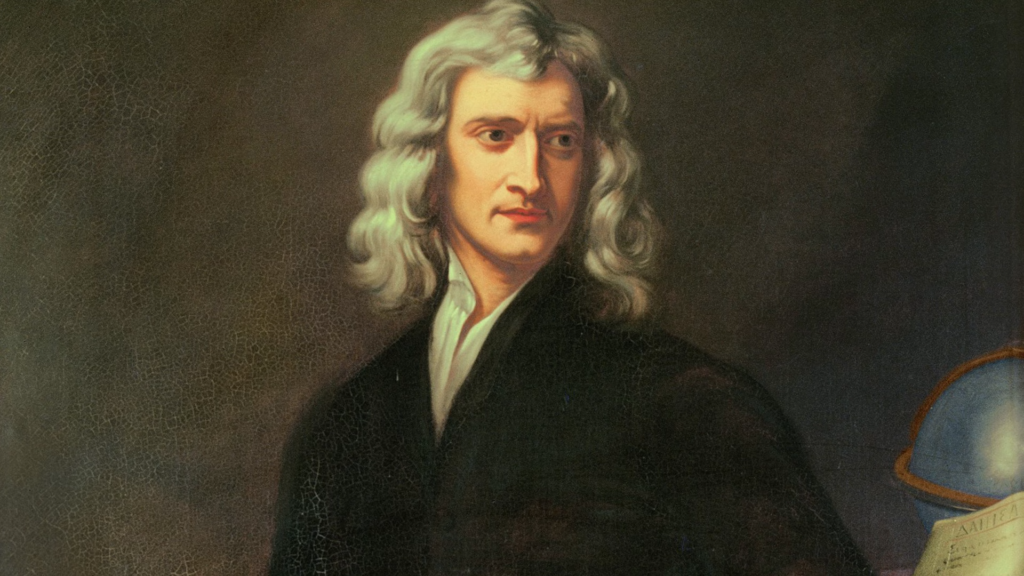
The Early Years
Isaac Newton was born in Woolsthorpe, England, to a humble family. His early life was marked by hardship and challenges, but he displayed an insatiable curiosity from a young age. After his mother’s remarriage, he was sent to live with his grandmother, where he immersed himself in books and experiments. Despite facing academic setbacks during his early education, Newton’s passion for learning drove him to study at Trinity College, Cambridge, where his intellectual brilliance began to shine.
The Laws of Motion
Newton’s most renowned work, “Philosophiæ Naturalis Principia Mathematica” (Mathematical Principles of Natural Philosophy), published in 1687, laid the groundwork for classical mechanics. In it, he proposed his three laws of motion, which transformed our understanding of how objects move in the universe. The first law, the law of inertia, posited that an object at rest will remain at rest, and an object in motion will remain in motion unless acted upon by an external force. The second law, commonly stated as F = ma, established the relationship between force, mass, and acceleration. Lastly, the third law of motion states that for every action, there is an equal and opposite reaction. These laws formed the cornerstone of classical mechanics, enabling accurate predictions of motion and changing the way we perceive the physical world.
Universal Gravitation
Among Newton’s most significant contributions was his law of universal gravitation, which explained how massive bodies interacted with each other. He deduced that every object in the universe attracts every other object with a force proportional to their masses and inversely proportional to the square of the distance between them. This revolutionary insight not only explained why objects fell to the ground but also elucidated the motion of celestial bodies. Newton’s law of universal gravitation provided a unifying framework for understanding the cosmos, cementing his place as a scientific luminary.
Optics and the Prism Experiment
In addition to his contributions to mechanics, Newton made pioneering discoveries in optics. His work on the nature of light demonstrated that white light is composed of a spectrum of colors. He conducted a famous experiment using a prism, wherein he separated sunlight into its constituent colors, forming the rainbow spectrum. Newton’s experiments with light and his theory of color laid the foundation for the field of optics and significantly advanced our understanding of the properties of light.
Mathematics and Calculus
Newton’s impact on mathematics cannot be understated. He developed the foundations of calculus independently of the German mathematician Gottfried Wilhelm Leibniz, a subject of historical controversy. Calculus revolutionized mathematics, providing powerful tools to understand and describe dynamic processes, such as motion and change. His mathematical insights and methods are still fundamental in various fields of science and engineering to this day.
Isaac Newton’s life and work remain an awe-inspiring testament to the power of human intellect and curiosity. His unparalleled contributions to physics, mathematics, and optics reshaped the world of science, paving the way for subsequent generations of researchers and thinkers. Newton’s laws of motion and universal gravitation, along with his work in optics and calculus, provided a robust framework for understanding the natural world and influenced the evolution of science for centuries to come.
Beyond his scientific achievements, Newton’s dedication to empirical observation and his unwavering pursuit of knowledge serve as timeless lessons for aspiring scientists and scholars. His spirit of curiosity, perseverance, and relentless pursuit of truth continue to inspire researchers and thinkers across disciplines. As we marvel at the profound impact of Sir Isaac Newton, we are reminded that the secrets of the universe lie waiting to be unraveled by those who dare to dream and explore the unknown.