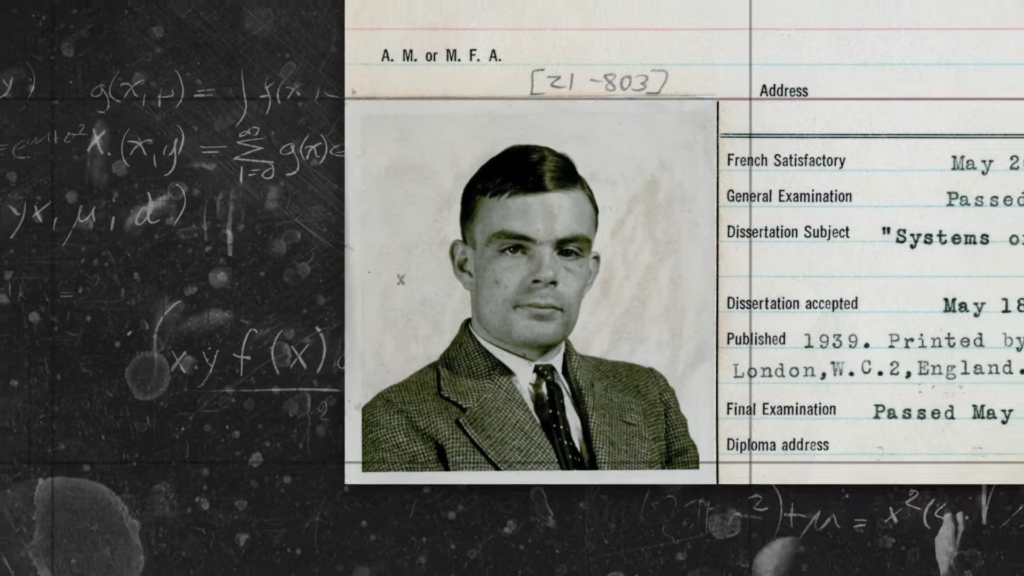
In the annals of history, certain individuals stand as beacons of innovation, reshaping the contours of human knowledge and potential. Alan Turing, a mathematical prodigy, codebreaker, and visionary thinker, occupies a significant place among these luminaries. Beyond his instrumental role in deciphering the enigma of the German code during World War II, Turing’s profound insights into the realm of artificial intelligence (AI) and modern computing have indelibly shaped the course of our world. This article delves into the life, contributions, and visionary foresight of Alan Turing, a man who not only changed the course of history but also laid the foundation for the digital age.
The Early Years and Formative Ideas
Born on June 23, 1912, in London, Alan Mathison Turing displayed an early aptitude for mathematics. His fascination with mathematical puzzles and logical conundrums foreshadowed the revolutionary ideas he would later introduce. Turing’s exploration of the foundations of mathematics laid the groundwork for his concept of the “Turing machine,” a theoretical device that could compute any problem that is computable.
Codebreaking and World War II
Turing’s name is closely tied to his wartime efforts at Bletchley Park, the top-secret center for codebreaking during World War II. His leadership in cracking the German Enigma code significantly hastened the end of the war, potentially saving countless lives. Turing’s invention of the “Turing bombe,” a device capable of deciphering complex Enigma-encrypted messages, showcased his exceptional problem-solving skills and practical genius.
The Turing Test and Artificial Intelligence
Turing’s visionary ideas reached their zenith in his contemplation of artificial intelligence. In 1950, he published a seminal paper titled “Computing Machinery and Intelligence,” in which he introduced what is now famously known as the “Turing test.” This test proposed a criterion to determine whether a machine possesses true intelligence. Turing posed the question: Can a machine engage in conversation indistinguishably from a human? This inquiry paved the way for the exploration of AI’s potential and the ethical considerations it entailed.
Breaking New Ground in Computing
Turing’s ideas transcended theoretical musings. He delved into practical aspects of computing as well. His design for the Automatic Computing Engine (ACE) outlined a blueprint for a universal digital computer, capable of executing a wide range of tasks by following a set of instructions stored in its memory. Turing’s ideas were fundamental in shaping the architecture of modern computers, marking a paradigm shift from mechanical calculators to programmable digital systems.
Persecution and Legacy
Despite his remarkable contributions, Turing’s personal life was marred by societal prejudices of the time. In 1952, he was convicted of “gross indecency” due to his homosexuality, which was criminalized in the United Kingdom. Turing faced chemical castration as an alternative to imprisonment. Tragically, he died in 1954 from cyanide poisoning in what is widely believed to be suicide.
It wasn’t until decades later that Turing’s contributions were fully recognized and celebrated. His groundbreaking ideas laid the theoretical and practical foundation for modern computing and artificial intelligence. In 2013, Turing was posthumously pardoned by Queen Elizabeth II, acknowledging the injustice he suffered due to his sexual orientation.
Alan Turing’s life and work are a testament to the power of visionary thinking and the resilience of the human spirit. His contributions to codebreaking, theoretical computer science, and artificial intelligence have permeated every facet of contemporary society. Turing’s ability to bridge the theoretical and the practical, the mathematical and the human, has left an indelible mark on the world. As we navigate the complexities of an AI-driven future, we owe a debt of gratitude to Turing, a man who envisioned the potential of machines to think, learn, and change the world.